Thursday, October 31, 2013

5 Myths About Traveling By Bicycle

From http://www.twowheeltravelblog.com/reposted from Two Wheel Travel, with permission by Tyler Robertson

Bicycle travel doesn’t have to be hardcore.  You can even bring your knitting

After reading Julie Huck’s article,  “Knitting Club tackles trail of the Coeur d’Alenes”,  on the Adventure Cycling blog, Carolyn and I started talking about the all myths surrounding overnight bicycle travel that might keep people from actually trying it.  In her post Julie shares a recent experience convincing her knitting club to go on an overnight bicycle trip.  Since most of the group had never done an overnight bicycle trip, it sounded difficult and messy at first glance.  The knitters were reluctant until Julie countered their arguments with easy, simple solutions.  Proving to her friends that bicycle travel, even overnight bicycle travel, doesn’t have to be hardcore to be fun.  Anyone can do it.
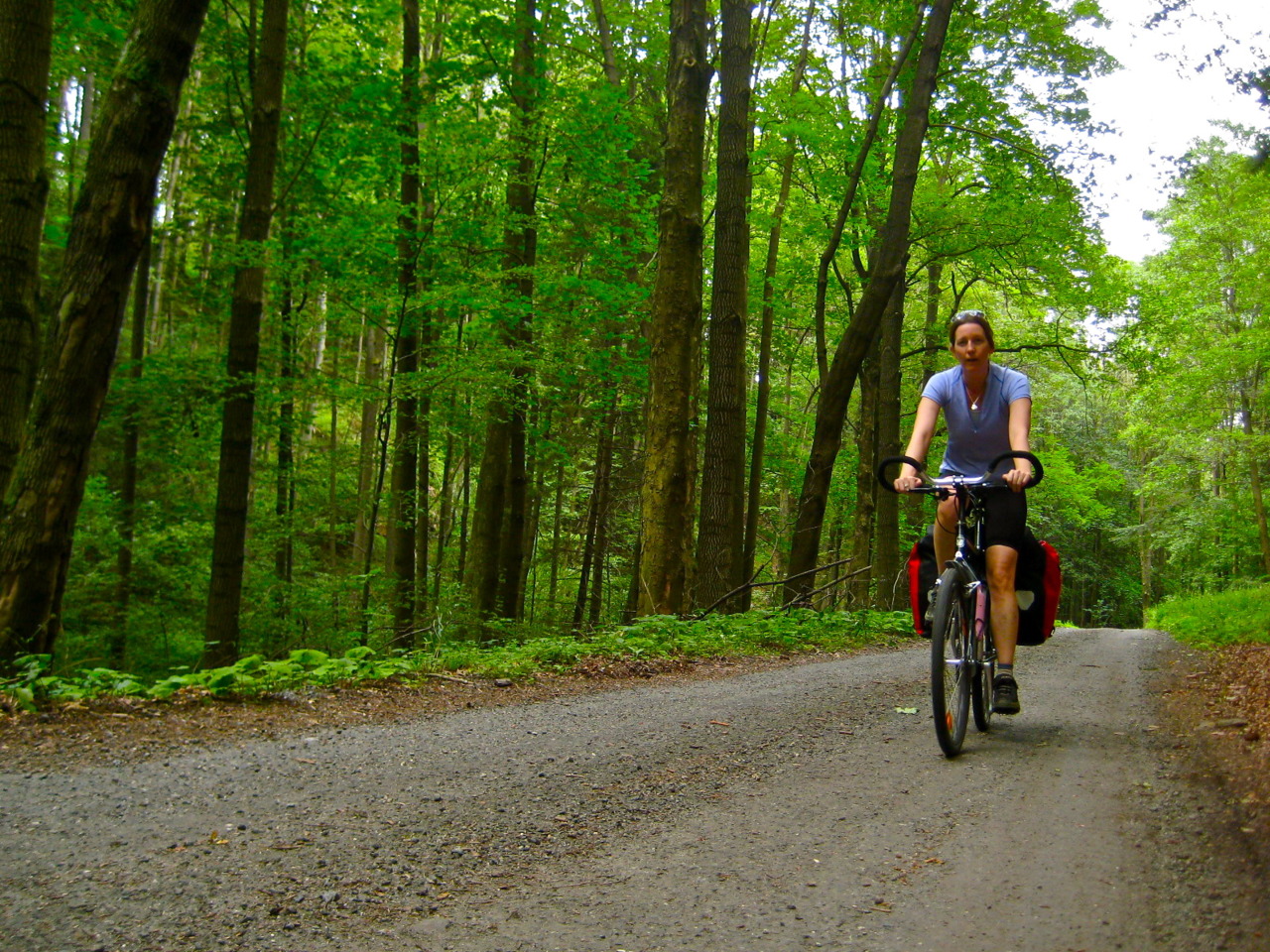
bicycle touring can be easy; bike travel; two wheel travel
Carolyn pedaling on a quiet gravel road.
Czech Republic. Spring 2011

Bicycle travel is not as hard as you think

With the idea that overnight bicycle travel needn’t be hardcore to be fun we began plumbing the depths of bicycle forums, message boards, asking friends and the like to come up with the “Top 5 myths about bicycle travel and how to dispel them”.
Here’s what we found:
  1. You have to be a hardcore adventurer
  2. You need special, expensive equipment.
  3. Weather- It’s too hot / too cold.
  4. You need to be a bike mechanic
  5. It’s not safe
Remember as we go through list below, we are talking about beginning bicycle travel for the newbie or someone who might be an avid cyclist but has just yet to take the jump to overnight travel by bike.  We want to keep the distances short and the investment in equipment minimal.  This list is not meant to be the definitive bicycle tourist’s kit list nor a technical primer, but rather an introduction on how someone might try a bicycle overnight and overcome some of the myths surrounding it.

Dispelling the myths about bicycle travel


1.You have to be a hardcore adventurer (a.k.a. I can’t pedal very fast or far…)
Like the example of the Knitting Club above, bicycle overnight travel doesn’t have to be hardcore to be fun.
You don’t have to go fast.  You should see me.  I redefine slow.  I sometimes need to speed up just to stop. :)  Our experience tells us that some of the best places are often close by and some of the easiest trips.
multi-modal bike travel, bicycle touring in europe; bike on train
Bikes on a train:  Multi-modal bicycle travel
Pedal at your own pace, to a destination that is within your reach.  The idea is to get out on your bicycle and go someplace.  Even if that place is only on the other side of town.  It’s just fine as long as you enjoy it.
You don’t have to go far.  One option we use regularly for extending our trips is public transit.  We use buses and light rail to extend our range or cut down travel time.  Check with your local Public Transit agency to see if they will carry bicycles and how they must be loaded on and off the bus or train.  After that, it is as simple as picking a destination that is within your range.  Remember bicycle travel is about having fun. So have fun. Go someplace on your bike.  You can do it.
 2. You need special, expensive equipment.
Trek; Touring bike on a budget; Two Wheel Travel
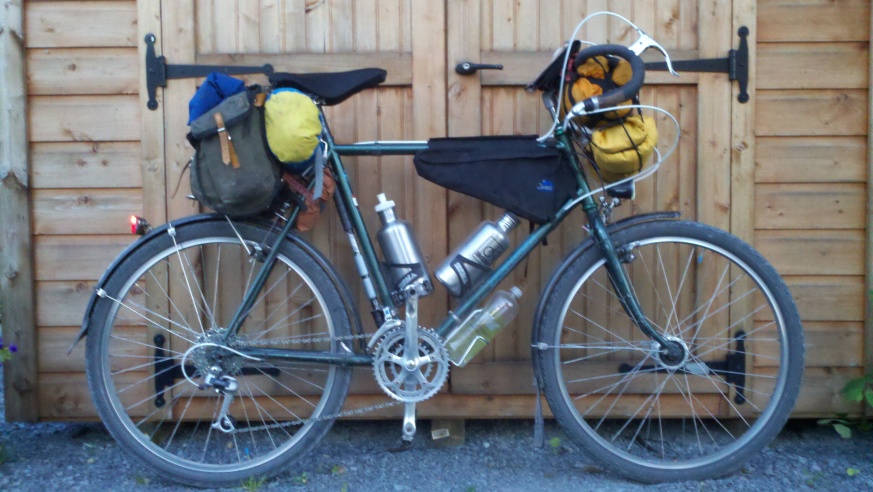
You can tour on an old Mountainbike
Bicycles. While a purpose built touring bike is great, particularly for long distance trips and multi-day adventures, it’s not required.  As Carolyn pointed out in her post “Touring bike on a budget…”, it is possible to convert an old Mountain Bike to a great touring rig with a relatively minimal investment.  A City Bike / Hybrid is another good option as long as your travels don’t take you too far off-road or require you to carry extremely heavy cargo. You can ride just about any bicycle that you have.  What matters is that it is comfortable over an extended distance and your bike has some means for carrying cargo.
Panniers. While there is a certain pleasure in having nice touring panniers, it is not a stopper by any means.  If you’re sure that bicycle travel is for you, then by all means invest in a quality set of waterproof panniers, like the Ortlieb Classic Rollers.  Nothing can beat them.  If you are not yet sure, or perhaps this is your first overnight its not a problem to improvise.  A basket, milk crate or a book bag lashed to a rack can hold a remarkable amount of cargo if you pack creatively.
minimal bikepacking; bicycle travel; gypsy by trade; two wheel travel
You can lash light, compact items to your handlebar and saddle.
Photo by Nicholas Carmen at  Gypsy by trade
You can also simply lash some of your lighter, more compact cargo, like a sleeping bag or pad, to the front of your handlebar or saddle rails. Make sure your cargo doesn’t interfere with your brakes and shifters.  Nicholas at Gypsy by Trade swears by this technique and finds it superior to panniers over rough terrain as his cargo is more aligned with the center axis of the bike making it easier to handle than with panniers.
Make certain when lashing items onto your rack, handlebar or saddle that you secure these items very well.  The constant motion can entice your cargo to take a tour of its own if not secured, and no one wants that.
3. Weather- It’s too hot / too cold.
Be prepared, but not overly so.  . While we can’t offer any tips or tricks on how to change the weather while you are on your overnight bike trip we can offer some basic advice on how to be prepared for what ever Mother Nature throws at you.
Make sure you wear light, breathable clothing in hot weather and bring a hat if you’ll be out during the heat of the day.  Take lots of breaks. Drink lots of water.  Pace yourself.  Bicycle travel doesn’t need to be a race.  Relax.  Stop and swim, eat some ice cream, check out a farmer’s market…this is supposed to be fun.
In cool or cold weather, bring light layers, mostly wool.  Cotton is out.  It absorbs moisture (sweat, rain etc…) and is heavy.  A light wool sweater is perhaps the best piece of clothing I could ever think of having on a bicycle trip.  In fact we almost always have wool clothing with us even in the summer, it can get cool at night.  Wool is naturally water repellent and stays warm even if it’s wet and doesn’t smell after repeated use.  Pack light. Remember you don’t have to prepare for arctic weather (unless you’re cycling in the arctic, and if you are, why are you reading this…?), you’ll be moving and staying warm.  Bring a rain jacket with pit zips.  Again, we bring this item summer and winter.   You never know when it will rain.
So what do we mean about not being overly prepared? Pack light.  For a bicycle overnight trip you will rarely need 2 of any piece of clothing, except socks or underwear.  You won’t need as much clothing as you think.
We always use one simple rule for packing clothing: One set of clothes on the bike and one set of clothes off the bike plus a rain jacket.
clothing for an overnight bicycle trip for two people; two wheel travel; bicycle touring
Clothing and sleeping bags for 2 people for a 2 night bicycle trip.
Sometimes these clothes can overlap further reducing the need for extra clothes.  My basic packing list for a 2-night bicycle trip is: bike shorts, underwear, 2x socks, wool t-shirt, wool sweater, rain jacket, swim trunks or shorts, hat, flip-flops.  This entire load will fit in a stuff sack while riding, since I’ll always be wearing half of it at any time.
4. You need to be a bike mechanic
I can’t change a flat tire. Like the last point, we can’t offer any secret tricks to avoiding basic bicycle mechanics, but we can tell you this: There is no substitue for a well maintained bicycle, BUT you don’t need to know much to get started.
The basic skill needed for short bicycle overnight trips is flat tire repair. You should always know how to change a flat at the very least. The basic tool kit is cheap and easy to carry:  A spare tube, tire levers and a small pump.
basic repair kit for a flat tire bicycle; bike touring; two wheel travel
The basic flat repair kit: inner tube, tire levers and a small pump
If you don’t know how to repair a flat ask a cyclist friend or check out the multitude of instructional videos on youtube.  It’s really not hard.
Now it could be said that a well maintained bicycle is less likely to break down.  No doubt.  That is absolutely true.  However the likelihood of a catastrophic breakdown on a short trip is less if your bike has been serviced recently.  If you’re planning an overnight bicycle trip and your bike hasn’t been serviced lately it is a good idea to take it to your bike shop for a check over.  After that you should be OK for short, lightly loaded touring even with a minimum of mechanical know-how.
If you plan on doing longer and more heavily loaded tours nothing beats a basic knowledge of bicycle mechanics and some crucial tools.  Check out Sheldon Brown’s encyclopedia of bicycling for almost everything you ever needed to know and more.
5. It’s not safe
Isn’t it dangerous? Everyone has a limit of risk vs. reward.  No need to be uncomfortable or feel unsafe, but the facts are that bicycle travel is safe as long as you use common sense and follow the basic rules of the road.  If you’re still unsure it doesn’t hurt to get some help, whether that is instruction and/or guided support.
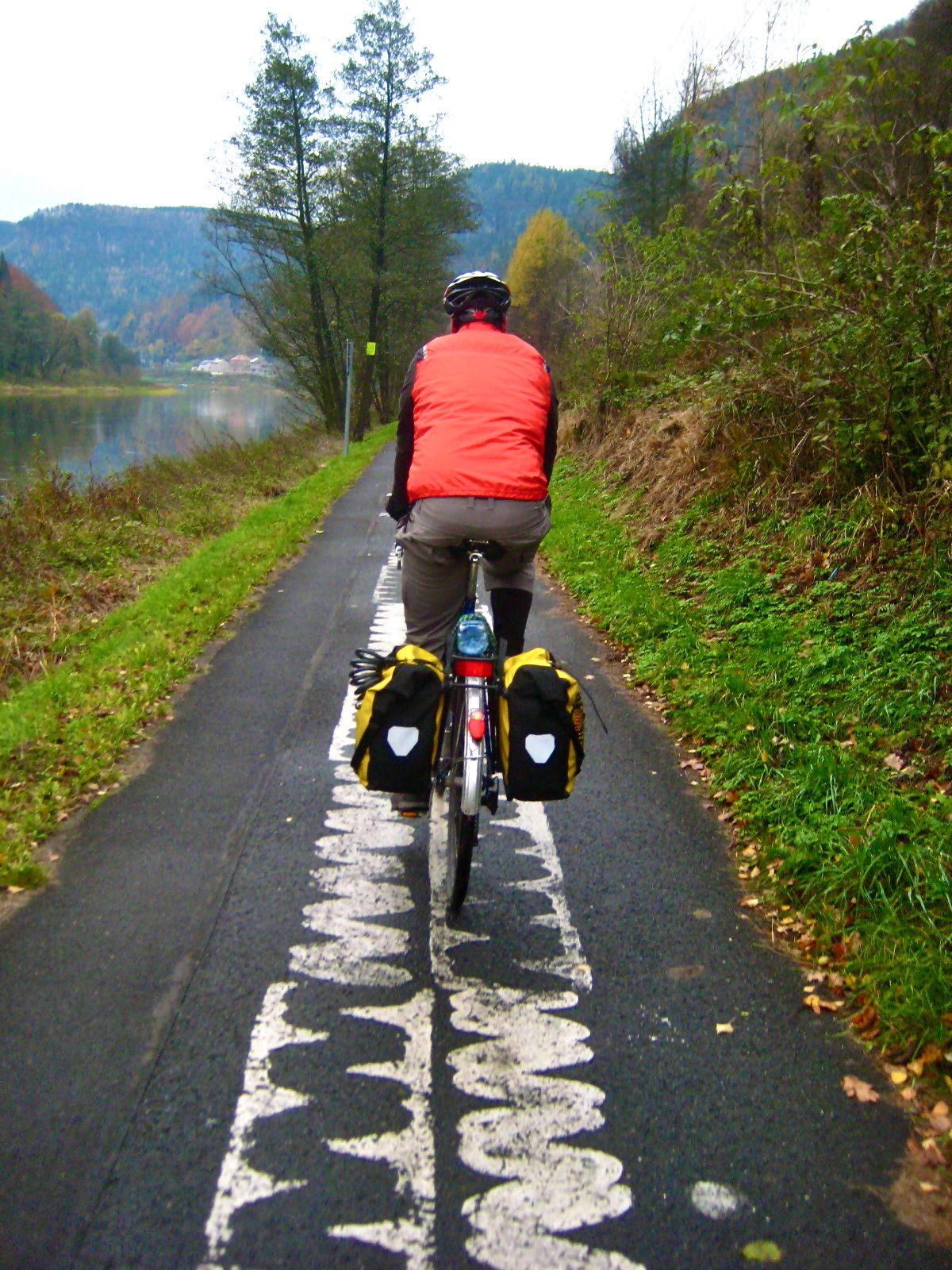
bicycling on the elberadweg; cycling on an off road path; two wheel travel
Bicycling an off-road path.
There are also off-street paths that can help you get to your destination safely and comfortably.  Some long, Some short.  Check your local Parks and Recreation offices and Bicycle Advocacy groups to find out what is near you.
In Portland we have the Springwater Corridor, a well-used trail leading from the city center to the suburb of Boring, OR(MAP).  It’s also common to combine MAX, our local light rail, with biking to get out to Stub Stewart State Park for a bicycle overnight, even with the kids.  In Missouri is the famous Katy Trial, runs 237 miles across most of the state.  Over half of this trail follows Lewis and Clark’s route along the Missouri River and is dotted with history and accommodations.  In the East there is the C&O canal trail, which is now linked to the Great Allegheny Passage trail for a combined total distance of 330 traffic free miles from Washington DC to Pittsburg, PA.  Of course none of these trails require that you ride the full distance.
Now all that’s left is to pick a destination no matter how short or long and get out there and travel by bicycle.

About Tyler Robertson

Passionate about bicycling, photography and great tacos, Tyler is always happiest when in the saddle. Now living in and exploring Eastern Europe by bicycle, he often spends time analyzing how bicycles can change the face of travel and the economic landscape while planning his schedule around bicycle trips (instead of the other way around). If you would like an opinion or contribution on any of the above, please contact Tyler.
   

Monday, September 23, 2013

Letter from a Carfree woman for life!

"Hi Mr Poindexter:                                                                                      

I was reading the blog called car-free American and saw your wonderful article from December 2012. I have never owned a car in my entire life, mainly due to economics.

 I am a single black woman living in Columbus, Ohio. I work as a home based data entry operator and telephone customer service agent. I have had various office jobs over the past 20 years and have always used mass transit. I have been lucky to get jobs that were close to the bus lines. I never liked driving and did not really take any driving lessons until I was in my late thirties. I took some driving lessons at one of those driving schools and hated every minute of it. I was in a student driver car and the other drivers were so nasty and rude. If you drive at the proper speed limit, they get really mean and nasty. They will blow their horn at you and give you dirty looks. I took these lessons for about a few months back in 2002, but never did get my driver’s license because I could not pass the parking part of the road test. I decided to give up driving altogether and stick with walking and using mass transit. 

The bus system in Columbus, Ohio is called COTA, which stands for Central Ohio Transit Authority. I have been riding COTA for over 20 years.

 I do not regret being car free, especially in the last 5 years as gasoline prices have gone way up. Back in the 1990’s and early 2000’s,

 I used to get teased mercilessly at work and looked down upon because I did not own a car. Some times I would ignore these people and other days I would get depressed.  In the last few years, since gasoline is well over $3 a gallon, I don’t get teased as much as I used to. I think that the last recession brought many people to reality as far as over consumption is concerned. Now, I see many more people ride the COTA buses to work, school, grocery shopping, etc. COTA has recently expanded the bus routes and added newer, more efficient buses that run on biodiesel, natural gas and hybrids. In the downtown of Columbus, new bike racks have been installed. 

Many people of all income levels are either biking or using mass transit.

It was refreshing to read about someone like you who seems well-off, affluent and successful, ditch the car and go car-free. Now I see more people who are way better off than I am go car free or car lite.

 I am a single woman who makes less than $30,000 per year and a car would put me into bankruptcy. I only pay $62 per month for a local bus pass that allows me to travel all over Columbus. My condo is only a 5 to 10 minute walk to the bus stop. I also can walk to the post office and to the nearest shopping mall. I can take one bus to a really nice mall called Easton Town Center, which has everything.  Sorry for the long email, but I just needed someone to talk/write to that can relate to my situation. I also plan to get a bike sometime in 2014. I still will use the bus for most of my transportation needs, but want a bike for the exercise. 
Take care,
Sharon Lewis


What a great note Sharon! Thanks so much for sharing! You an inspiration.

Bill Poindexter aka Mr. Carfree American 

Wednesday, May 22, 2013

yoga, touring, and roads less traveled


yoga, touring, and roads less traveled...

Kristina, Yoga Instructor at Yoga Patch in Kansas City
I have always and will take the road less traveled in life. That path makes sense to me.

 I am working hard to live my live in the moment, rather than in the past or future. Three thing currently helping me live a fuller life are: Yoga, bicycling touring, and an awareness of the road I have taken in life.


 I found a Yoga studio, only five blocks from my home, the Yoga Patch, and as I was arriving for my class, Kristina, one of our gurus, rolled in on her bicycle. She is a superb teacher, and the fact she rides her bicycle for transportation made the class more special. 


Bill doing Tree pose while four birds are watching from a branch
at Middle Creek lake outside of Louisburg, Kansas
As I come into my fifth year of living carfree, I realize, this is a lifestyle that I will embrace for the remainder of my life.

I recently took a S24O (sub 24 hour overnight bike tour) with my good friend Randy Rasa of the website Kansas Cyclist fame. Even on that trip I was able to interject the tour with some high quality yoga moments. Randy did a nice write up with great pictures of the tour on his site.

A clarity of thought, breath deep in my belly, finding roads less traveled. 

What road are you going to take?

Peace and Love, 
Bill


The poet Robert Frost says it best...


The Road Not Taken
Riding with Randy always promises
taking roads less traveled...
Two roads diverged in a yellow wood,
And sorry I could not travel both
And be one traveler, long I stood
And looked down one as far as I could
To where it bent in the undergrowth;

Then took the other, as just as fair,
And having perhaps the better claim
Because it was grassy and wanted wear,
Though as for that the passing there
Had worn them really about the same,

And both that morning equally lay
In leaves no step had trodden black.
Oh, I kept the first for another day!
Yet knowing how way leads on to way
I doubted if I should ever come back.

I shall be telling this with a sigh
Somewhere ages and ages hence:
Two roads diverged in a wood, and I,
I took the one less traveled by,
And that has made all the difference. 

Monday, March 4, 2013

Cycling In The Metro


CYCLING IN THE METRO: KANSAS CITY'S UPS AND DOWNS FOR RIDERS AND COMMUTERS

Written by  Eden Williams


In truth, the ease (or difficulty) of commuting affects our entire city, not just me. Biking isn’t just a fun, recreational activity reserved for the trails – and commuting by bike isn’t just for tree-huggers, either. Commuting by bike can, and does, have a tremendously positive effect on the well-being of the whole Kansas City community.
I’m what you might call an “urban enthusiast.” My entire life could be connected by a short latitudinal span of about five miles, from the River Market to the Plaza. Because my world requires little more than what I can access within my tight geographical bubble, I don’t find it unusual to bicycle, rather than drive, from Point A to Point B. My fiancé and I skip the horrendous Saturday morning parking at City Market by bicycling to the farmer’s market when the weather is nice. We bike to eliminate cab fare when we meet friends at bars. While working in the Crossroads Arts District, my commute home was just four minutes by bike, thanks to several crosswalks and one really big, really fun downhill coast. I love downtown Kansas City so much I can actually relate to those “Live, Work, Play” billboards you see along the highways leading to downtown, begging suburbanites to move back to the city limits.
However, my routine changed last year. I quit my job to start my own business, and, as a solopreneur (one-person business owner), I don’t have a fixed office where I spend my 9-to-5’s. My work is done all over town, from sales meetings in Overland Park to networking events at the Kauffman Foundation and everywhere else inbetween. My bubble has had to expand, and commuting via bicycle isn’t so simple anymore. In truth, the ease (or difficulty) of commuting affects our entire city, not just me.
Biking isn’t just a fun, recreational activity reserved for the trails –and commuting by bike isn’t just for tree-huggers, either. Commuting by bike can, and does, have a tremendously positive effect on the well-being of the entire Kansas City community.
If we focus solely on the money, there can be an enormous personal economic benefit associated with biking. As reported by NBC Business News, the average American spends $10,000 per car per year, a cost that can be at least partially offset by frequent biking. When I commuted to work, either by bike or by foot, I filled up my 16-gallon tank once a month (if that) and required less maintenance by decreasing my annual mileage. Not to mention, according to statistical analysis by Charlotta Mellander and Richard Florida, writing for “The Atlantic,” there is a positive correlation between a higher portion of bike commuters and affluence within major metropolitan areas. Then, there’s the whole part about encouraging daily exercise, reducing carbon footprints, unclogging rush hour traffic, higher rates of employee productivity, increasing foot traffic to local businesses and so on.
Given the many positives associated with a city rich with biking commuters, it’s frustrating that Kansas City’s landscape actually impairs bikability. The aggressive annexation of the mid-20th century pushed the city limits outward, rather than inviting civilians in. We were left with a massive case of suburban sprawl and one of the lowest population densities for a city our size. This tendency for expansion, in addition to Kansas City’s naturally hilly landscape, deters some of the less determined would-be cyclists. Not to mention, the lack of prevalent biking lanes are natural barriers to a robust biking community. For these reasons, it’s easy to understand why Kansas City stacks up poorly compared to other metro areas in terms of biking.
Based on statistics compiled by the League of American Bicyclists, just 0.3 percent of commuters bike in Kansas City, Missouri, which is half of the national average. Overland Park and Olathe both rank even lower at 0.2 percent. Patrick Dunlap, an avid cyclist, has kept an eye on some of the city’s efforts to make Kansas City more bikable, and the news is not all negative.
“Many younger Americans want clean, environmentally-progressive, community-oriented, healthy cities to call home,” he said. “This has led the City of Kansas City to at least play lip service to the idea of improving biking conditions here.“
One such positive development has been the B-Cycle program, which launched last year in downtown Kansas City, Missouri. B-Cycle is a bike-sharing program, sponsored by BikeWalkKC, which allows members to rent bikes at any of the 12 stations located throughout downtown, and then return the bike to any of the stations. Memberships are available from one day to one year, so even visitors to the city can take advantage of this convenient way to get around while downtown. The program has provided 5,320 rides, for a total of 13,622.44 miles, 544,897.51 calories burned and 12,941.32 pounds of offset carbon emissions since its launch on July 3, 2012, says BikeWalkKC’s Director of Communications, Sarah Shipley.
“It was a remarkable summer for transportation,” said Shipley. “Biking is quickly becoming the center of an active, healthy lifestyle and we are excited that Kansas Citians have embraced Kansas City B-cycle as a way to get around town.” Other improvements are due in part to several organizations dedicated to furthering the bicycling community in Kansas City, including the 816 Bicycle Collective, for which Dunlap is a volunteer mechanic.
The 816 Bicycle Collective reclaims old bikes that would otherwise be discarded and refurbishes them to safe working condition. These bikes are then either sold to the general public or provided to low-income individuals through a special program aimed at helping these individuals get reliable transportation.
“I (have) been surprised to learn what a dynamic bike community we have in KC and am proud to see it continually improving,” Dunlap said. And he represents a tough audience to please. Dunlap moved to Kansas City to begin his engineering career after earning his master’s degree from the University of Texas in Austin – home to one of the best bike scenes in the country.
The last piece of the puzzle to make Kansas City bike-friendly is also one of the most important: the addition of biking lanes throughout the metropolitan area. Bike lanes make the roads safer for bicycles and cars to share. Plus, the road markings alone bring awareness to the cause for bicycle commuting. Last fall saw the addition of bike lanes on Southwest Boulevard as a part of KCMO’s road re-paving program, as well as the groundbreaking on improvements to Longview Road, which will ultimately include bike lanes. Many of these improvements have come due to the efforts of bike advocacy organizations, such as BikeWalkKC. But the continuation of bike accessibility improvements will depend on the community and the expressed desire to city councils and other governing bodies to have a bike-friendly community.
In Dunlap’s words, “improving bikability and promoting biking as a legitimate method of transportation in Kansas City is not just a struggle against the geography, humidity, or tight city budgets; it is a struggle to also change the culture.”

Article reprinted with permission of Sarah Legg, Editor In Chief, Living Wellness Kansas City if you have comments or article ideas, or would like to subscribe feel free to reach out to Sarah!

PS I am the male in the picture! Enjoy, Bill Poindexter aka Carfree American

Thursday, February 28, 2013

Cross Country Skiing with my bicycle


CROSS COUNTRY SKIING WITH MY BICYCLE
I love winter when we have a lot of snow! This last week, in Kansas City, Missouri where I live we have had about 13-20 inches, making a dull winter very lively…if you like this sort of thing.

I have been going to the gym a lot, but prefer being outside walking or cycling. Now with all the snow I am able to do my favorite winter sport, Cross Country Skiing.

Right after a good snow, and before the plow trucks and cars muck up the streets I am able to slap on the ski’s and transport myself anywhere.

If you have not tried XC Skiing, you are missing out, it is a lot of fun and a great workout, but as with walking and cycling for transportation, you can go at your own pace. I originally learned how to xcski at boarding school in Cheshire, Connecticut. There were 100 acres of woods with great trails. 

One of the best things about being carfree is getting to use your creative juices to figure out how to get from point A to point B with out the use of a smog belching vehicle.

I love being able to use my bicycle as a ski holder while I ride to Loose Park and other trail heads around the City for some quality Ski time. 

Spring is around the corner, OK way around the corner, but until it arrives I want to play with my ski's.

Tell me about your winter sports on our adjoining carfree American Facebook page! 

Sunday, January 13, 2013

15 Car-Free Myths and Truths

15 Car-Free Myths and Truths
By Bill Poindexter aka “The Car-free American”

1. It is hard to live car-free!
False. It is not hard to live car-free. It may be inconvenient, but not hard. Think about it, people had been living car-free up to the early 1900s. No one died because they did not own a car, nor will you if you go car-free or car-lite. It takes time to get use to it, but it all comes together and becomes more natural than car use. Basically being carfree is getting back to nature-you get healthier, it is good for environment, and you meet your community-face to face rather than car to car. It is also nice to save money.

2. It is always fun
True: Most of the time it is FUN. Usually the weather is the fun or non fun factor. But there are other factors too; heavy traffic, if you are tired, or sick, or a strong headwind. Then again, those are all factors that make driving a car not fun too.

3. People look down at you
True: sometimes they do. That is ok; at the end of the day most secretly wish they could live carfree. Everyone will tell you that it is "cool."

4. You have to have special equipment
False: Good walking shoes and a bicycle. And you do not have to have an expensive bicycle, just one that works well for you. Overtime you’ll figure out your own personal style of transportation. Keep it simple. If it roles and feels good go with it. Take your time, do not spend alot of money.

5. You will lose a lot of weight
Maybe, if you burn off more than you take in. You will get fit-that is for sure. Diet is still important though, I recommend a "whole food" diet of non processed foods. Raw nuts, Olive oil, fresh vegetables, quality protein, berries, whole cheeses will give you all the energy you need...I recently lost 70+ lbs eating the above foods.

6. You will save money
True: No more gas! No more insurance! No more car payment! No more personal property tax! No more oil changes! I think the last time I figured I save about $8,000 per year (what I spent the last year I owned a car).

7. You cannot live carfree if you have a young family
False: You can, millions do, it is just more inconvenient until you become use to it. It is definitely easier in more urban settings and some suburban. If you live in the country it may not be practical, in which case a car is necessary, but it does not mean you have to use it all the time. Kids are carfree, and they make it work. Don't use your family as a excuse, instead use them as the primary motivation for living a healthier lifestyle!

8. You will get hit by a car or crash
Big false: Nonsense! Only if you don’t pay attention to your surroundings. The odds are still in your favor…not to get squished. I have spent 10 years riding in traffic a have never been hit by a car. I ride with the assumption the drivers do not see me. If you have a driver's license you know the laws, obey them and you should be ok walking or bicycling for transportation.

9. People will make fun of you if you do not own a car and /or bike places
False and true: Well, if they do, make fun of them back. They are jealous you are out enjoying yourself. I find that most people want to be carfree, I mean, when they go on vacation, they don't want to go someplace they have to drive all the time, no, they want to go some place to relax, walk or bike.

10. You will instantly be “Green.”
False: There is more to being green than just using alternative transportation. Carfree is a step in the right direction. A BIG STEP.

11. You will miss out on event because you won’t be able to get there.
True, sometimes that does happen, but you will be able to see and feel much more than you ever have in a car, so you’ll gain much more richness in your life. You will also learn to support events in your local community and you will add value as you arrive by your own steam. It makes your transportation an adventure!

12. I will have to own special clothes for bicycling?
False: You can wear anything you want. If you are riding longer than an hour, you may want to make sure you are wearing something comfortable. Bike shorts were made for a reason. Time on the bike will be your best teacher. I now rarely wear specialized gear or shoes. I keep it simple and comfortable.

13. I do not have time to be car-free
False: most Americans waste a crap load of time in their cars going to places they don’t need to go to or watching TV. I suspect you could find a bit of time to get healthier, save the environment, and make your community stronger. There is always time to do something good for you. It comes down to needs versus wants-“do I really need to drive to the Wal-Mart to buy more crap I don’t need.” Or “can we hop on the bikes and go to the local store to buy what we really need?” Then again...there are exceptions:)

14. Car-free means never owning or driving a car
False: It is a little confusing I admit. Typically Car-free means living with out a car and Car-lite means owning a car, but using it on a limited basis. Any journey you take without the use of a car, no matter the distance, is car-free.

15. Living car-free makes me happy!
Bill's bicycle with the bags, has over 30,000 commuting miles on
it.
TRUE: I love the lifestyle. Living car-free has helped me become healthier, I feel like I am polluting less, I save money, and I have developed very strong relationships in my community because of my lifestyle.


Bill Poindexter lives in Kansas City, Missouri and has lived the highly evolved life style of living carfree.