Kansas City adopts Livable Streets resolution.
Kansas City, Missouri, January 27, 2011 - The Missouri Bicycle And Pedestrian Federation proudly announces a giant step forward for bicyclist, pedestrians and motorists today as the Kansas City Council adopts the city's first Livable Streets resolution 110069.
http://cityclerk.kcmo.org/liveweb/Documents/Document.aspx?q=NqJpNXtnk1JvB%2fxWC5843a%2f8iRslPm%2b%2fRgAgRmcSSA4tznDk%2fcMjkkg0ymAfSFJL
4th District Councilmember Beth Gottstein initiated the resolution, stating “This resolution will provide safe access to public roads for all users by encouraging transportation improvement plans consider the safety, access and mobility needs of all travelers, regardless of age or ability”
"Councilmember Gottstein has been a tireless supporter of Complete Streets efforts. From her work on the back-in angle parking demonstration to her participation in the annual Car Free Challenge, she has supported the bicyclists, pedestrians, and transit users in Kansas City, MO and across the metro area” states Eric Rogers, Vice President of the Missouri Bicycle and Pedestrian Federation.
This resolution, together with policy changes recently adopted by the city, helps to ensure that more Kansas City streets are designed and operated to enable safe access for all users. Pedestrians, bicyclists, motorists and transit riders of all ages and abilities will be able to safely move along and across a complete street. Kansas City is moving to the forefront of transportation parity in Missouri following the adoption of similar Complete Streets policies in Columbia, De Soto, Ferguson, Crystal City, Festus, Herculaneum, St. Louis, and Lee’s Summit. There are over 200 jurisdictions formally committed to Complete Streets according to Barbara McCann, the Executive Director of the National Complete Streets Coalition.
Brent Hugh, Executive Director of the Missouri Bicycle and Pedestrian Federation states, "A Complete Streets policy means our roads and streets are designed for everyone--the old, the young, people with a disability, people who walk, bicycle, take the bus, or drive. Complete Streets improve safety for all road users and may improve adjacent property values. This resolution is a great step forward for pedestrians in Kansas City – what a remarkable way to start the New Year."
For more information on complete streets visit
www.mobikefed.org/completestreets.
The Missouri Bicycle and Pedestrian Federation is a statewide, not-for-profit, membership organization that advocates advancement of bicycling access, safety and education in Missouri under section 501(c)(4) of the IRS code. mobikefed.org
RESOLUTION NO. 110069
Expressing the Council’s support for the concept of “Livable Streets” as a means to promote great neighborhoods, healthy and active people, and a thriving community.
WHEREAS, active living is a way of life that integrates physical activity into
daily routines, and the goal of active living is to accumulate at least 30
minutes of activity each day; and
WHEREAS, active living promotes walking and bicycling for transportation,
recreation and physical activity; and
WHEREAS, streets and sidewalks are an important part of our community that serve
transportation needs and are also a part of the public realm where people live,
shop, interact, and travel; and
WHEREAS, the built environment influences residents’ choices to be physically
active and may be designed to provide a variety of opportunities for physical
activity; and
WHEREAS, “Livable Streets” safely facilitate movement of people of all ages and
abilities from destination to destination along and across a continuous travel
network; and
WHEREAS, the design of each Livable Street differs based on the context of each
street; and
WHEREAS, a “Livable Street” is safe and inviting to pedestrians, bicyclists,
transit riders, the disabled, children, senior citizens, automobiles,
motorcycles and buses; and
WHEREAS, Livable Streets can be beautiful places built to pedestrian scale; and
WHEREAS, a Livable Street can be the focal point of tight-knit communities where
neighbors enjoy spending time; and
WHEREAS, Livable Streets are environmentally sustainable; and
WHEREAS, Livable Streets are economically thriving; NOW, THEREFORE,
BE IT RESOLVED BY THE COUNCIL OF KANSAS CITY:
Section 1. That Kansas City is committed to providing safe and livable
neighborhoods for residents to build community and be physically active.
Section 2. That Kansas City supports the concept of Livable Streets as a means
to promote great neighborhoods, healthy and active people, and a thriving
community.
Section 3. That the Livable Streets concept is consistent and complies with the
City’s efforts to develop a bike and pedestrian friendly, multi-modal and
sustainable community, promoted in several City initiatives including the FOCUS
Kansas City Plan, adopted under Committee Substitute for Resolution No. 971268
on October 30, 1997; the Bike KC Plan, adopted under Committee Substitute for
Ordinance No. 011288 on August 15, 2002; the Walkability Plan, adopted under
Resolution No. 030211 on March 20, 2 003; the Green Solutions Policy, adopted
under Resolution No. 070830 on August 9, 2007; the Climate Protection Plan,
adopted under Resolution No. 080754 on July 24, 2008; the Trails KC Plan,
adopted under Ordinance No. 081052 on November 20, 2008; and the Zoning and
Development Code, adopted under Ordinance No. 100394 on June 10, 2010.
Well done to all the activist and advocates in Kansas City to help make this possible!!!

Promoting healthy: bodies and minds, environment, and communities. The result of car-free/ car-lite life style.
Friday, January 28, 2011


Sunday, January 9, 2011
Mike's ride
“I knew I had it as early as 1999.” Mike Reiman told me in one of our interviews as he sipped his coffee. “I had symptoms, mainly the oscillating hand movements.” He seemed almost indifferent, telling me. One could see he has fully accepted the grasp of the disease, eleven years, after the first signs.
I first saw Mike on a weekly organized group ride in 2009, called the Brookside Ride, in Kansas City. The group was moving slowly up a long hill, and I noticed a rider solo rider ahead of me.
The rider seemed focused on the road ahead, but seemed overly careful and cautious, I could tell there was something going on even though his line was true.
Uncertain what his issue was, I chose to ignore him on that first ride together. The second time on the ride I passed him and made some silly comment about the weather. The third time, I saw him after the ride with a group of cyclists who went for food and drink at a local pub. I sat at another table, and later that night the Brookside Ride leader told me, after I inquired about this man's story, that his name was Mike, he had Parkinson’s and that he use to play with the Chicago Symphony, then moved back to KC after he retired and was living in Brookside with a relative.
Mike's story was worth telling. But I did not do anymore group rides that year and did not see him again.
A year later I saw him in the grocery store in Prairie Village and introduced myself. Then, a few months later, he was at a coffee shop in Brookside and we had the first of many long and interesting conversations.
“I grew up in Waldo, in Kansas City.” He said with a smile, “I got my first bike in 1968.” Staring out the window I could see he was thinking about the past.
Mike moved from KC to Chicago, and back to KC. He is living with a relative in Brookside. He lived in Chicago for a number of years, going there to study music at Northwestern. He played Trombone and the bass guitar. He studied with the Chicago Symphony and worked at golf course for his career.
“I started commuting to work and for errands in the 1980s; riding my bike for transportation made more sense than using my car.” He said with a serious tone, “By the time I got in my car, dealt with traffic, and parking, I found I could already be inside the store if I had ridden my bicycle.”
I asked him about the Chicago winters.
“I still rode in winter when I could.” He smiled, “I remember one time, when it was snowing heavily, I got on my mountain bike and rode to a restaurant to meet friends for dinner. There I was, fully bundled up, wearing a ski mask, rolling up on my bike. My friends just laughed.”
Mike developed symptoms of Parkinson’s and self diagnosed in 1999. “I wasn’t officially diagnosed with Parkinson’s until 2003” He stated as he looked me square in the eye, not seeking any recognition .
“Did you slow down your bicycling?” I asked.
“No!” He said with conviction, “I rode more!” He told me he did not want the disease to get the better of him and the more he rode his bike the better he felt.
And ride he did. Eventually, he moved back to Kansas City to live with a relative in Brookside. Bicycling became a life style and a way to keep the disease at bay.
Mike rides with a passion and unassuming peaceful quality. Over that last couple of years the disease has caused him to ride less. But he rolls on, and with the help of physical therapy, massage, chiropractor, and acupuncture, he has been able to continue riding and keep the pain at a manageable level.
“I am not able to get the 15-20 miles a day I was doing the last few years, but I am able to ride.” He said, then he told me about riding down to the Plaza and back from his home the day before we met for the interview, it was 25f degrees. He grinned "Just like anything else in life, I have my good days and bad days."
I asked what adventures he had lately and he excitedly told me he was able to ride the Katy Trail over the last two years.
“In 2009, I rode from Clinton, MO to Jefferson City.” He said proudly. “It was hot, July, and like a lot of people, I ran out of water. Luckily I met someone who shared some with me.” He said and he laughed, “Then I got caught in a four day rain and decided to stop at Jefferson City.”
In 2010 he finished the trail riding from Jefferson City, Missouri to St. Louis. “Last year was harder, there was more pain.” He said solemnly. “I finished though, and made a video.”
Mike is doing well, winter is here, and for someone with Parkinson’s winter is no fun. On our last interview in November, he told me he had been hiking on some mountain bike trails, yes, hiking. He is as active as he can be. Still riding when he feels up to it, no matter what the weather and staying active.
If you are lucky and in Brookside, you may just bump into Mike. Be sure to chat with him.
Mike you are truly and inspiration and I appreciate the opportunity to get to know you. You have a disease that is tough to live with, but your inner fire is stoked and I am excited for your future adventures. I look forward to riding with you soon!
Mikes Katy Trail video:
 |
| Mike |
I first saw Mike on a weekly organized group ride in 2009, called the Brookside Ride, in Kansas City. The group was moving slowly up a long hill, and I noticed a rider solo rider ahead of me.
The rider seemed focused on the road ahead, but seemed overly careful and cautious, I could tell there was something going on even though his line was true.
Uncertain what his issue was, I chose to ignore him on that first ride together. The second time on the ride I passed him and made some silly comment about the weather. The third time, I saw him after the ride with a group of cyclists who went for food and drink at a local pub. I sat at another table, and later that night the Brookside Ride leader told me, after I inquired about this man's story, that his name was Mike, he had Parkinson’s and that he use to play with the Chicago Symphony, then moved back to KC after he retired and was living in Brookside with a relative.
Mike's story was worth telling. But I did not do anymore group rides that year and did not see him again.
A year later I saw him in the grocery store in Prairie Village and introduced myself. Then, a few months later, he was at a coffee shop in Brookside and we had the first of many long and interesting conversations.
 |
| Getting ready for a downhill ride in the Rocky Mountain National Forest |
Mike moved from KC to Chicago, and back to KC. He is living with a relative in Brookside. He lived in Chicago for a number of years, going there to study music at Northwestern. He played Trombone and the bass guitar. He studied with the Chicago Symphony and worked at golf course for his career.
“I started commuting to work and for errands in the 1980s; riding my bike for transportation made more sense than using my car.” He said with a serious tone, “By the time I got in my car, dealt with traffic, and parking, I found I could already be inside the store if I had ridden my bicycle.”
I asked him about the Chicago winters.
“I still rode in winter when I could.” He smiled, “I remember one time, when it was snowing heavily, I got on my mountain bike and rode to a restaurant to meet friends for dinner. There I was, fully bundled up, wearing a ski mask, rolling up on my bike. My friends just laughed.”
Mike developed symptoms of Parkinson’s and self diagnosed in 1999. “I wasn’t officially diagnosed with Parkinson’s until 2003” He stated as he looked me square in the eye, not seeking any recognition .
 |
| Mike and I in PV |
“No!” He said with conviction, “I rode more!” He told me he did not want the disease to get the better of him and the more he rode his bike the better he felt.
And ride he did. Eventually, he moved back to Kansas City to live with a relative in Brookside. Bicycling became a life style and a way to keep the disease at bay.
Mike rides with a passion and unassuming peaceful quality. Over that last couple of years the disease has caused him to ride less. But he rolls on, and with the help of physical therapy, massage, chiropractor, and acupuncture, he has been able to continue riding and keep the pain at a manageable level.
“I am not able to get the 15-20 miles a day I was doing the last few years, but I am able to ride.” He said, then he told me about riding down to the Plaza and back from his home the day before we met for the interview, it was 25f degrees. He grinned "Just like anything else in life, I have my good days and bad days."
I asked what adventures he had lately and he excitedly told me he was able to ride the Katy Trail over the last two years.
 |
| Mike staying in a hotel caboose on the Katy |
In 2010 he finished the trail riding from Jefferson City, Missouri to St. Louis. “Last year was harder, there was more pain.” He said solemnly. “I finished though, and made a video.”
Mike is doing well, winter is here, and for someone with Parkinson’s winter is no fun. On our last interview in November, he told me he had been hiking on some mountain bike trails, yes, hiking. He is as active as he can be. Still riding when he feels up to it, no matter what the weather and staying active.
If you are lucky and in Brookside, you may just bump into Mike. Be sure to chat with him.
Mike you are truly and inspiration and I appreciate the opportunity to get to know you. You have a disease that is tough to live with, but your inner fire is stoked and I am excited for your future adventures. I look forward to riding with you soon!
Mikes Katy Trail video:
Saturday, December 4, 2010
Kansas Cyclist rolls 25,000 miles and still going strong
 Randy is the creator of the site Kansas Cyclist . It is an extraordinary informational website where he shares; resources, news, events, places to ride, advocacy info, trail information, photos, and a first class calender of rides for Kansas and the surrounding states. His podcast is full of information and features that has a NPR feel.
He also has a blog, DirtBum, where he is "exploring Kansas back roads by bike." The photos are incredible.
I first met Randy last year and realized his intense passion for cycling and all things regarding cycling. One of the most interesting things about this rogue computer programmer gone cycling addict, is his intense love for history and riding gravel.
If you happen to be driving on rural Kansas gravel roads, anytime of year, and you see a lone cyclist on a Surly Long Haul Trucker, (day or night), in the distance, it is probably Randy.
His knowledge of the local history and bridge history makes riding with him extremely interesting,
but be warned,
he likes gravel and minimum maintenance roads so bring your fat tires and have the time of your life!
Randy lives in the country and is carlite. I am amazed when he rides 20-30 miles from his home into the city for a "ride" and then rides 20-30 miles back out to the country, usually at night. A true adventurer, cycling advocate, photo journalist, historian, programmer, naturalist, lover of life and all things related to cycling.
Check out Kansas Cyclist, and DirtBum for more about Randy and his adventures! See some great photos! He is also on the board of directors for the State wide advocacy group KanBikeWalk
 |
| photo by Randy Rasa |
25,000 Miles
Congratulations to Randy Rasa for his epic milestone of riding 25,000 since he started keeping track of his cycling in 2004.
"Hit a big milestone on last night's ride: 25,000 miles (since I started keeping track in 2004). The Earth is 24,901 miles around. On my next circumnavigation of the globe, hopefully I'll have a chance to see more of it!" Randy said yesterday.
Randy is the creator of the site Kansas Cyclist . It is an extraordinary informational website where he shares; resources, news, events, places to ride, advocacy info, trail information, photos, and a first class calender of rides for Kansas and the surrounding states. His podcast is full of information and features that has a NPR feel. He also has a blog, DirtBum, where he is "exploring Kansas back roads by bike." The photos are incredible.
 |
| Randy and me on a Kansas City, Mo urban adventure |
If you happen to be driving on rural Kansas gravel roads, anytime of year, and you see a lone cyclist on a Surly Long Haul Trucker, (day or night), in the distance, it is probably Randy.
 |
| photo by Randy Rasa |
His knowledge of the local history and bridge history makes riding with him extremely interesting,
but be warned,
he likes gravel and minimum maintenance roads so bring your fat tires and have the time of your life!
 |
| Bill Poindexter, Randy Rasa, and Nitin Pai, on a gravel ramble to Louisburg, Kansas and surrounding area. Circa 2009 |
We salute Randy Rasa for his 25,000 mile trek. Congratulations!
Tuesday, November 30, 2010
Amie Lamb, a carfree story in Reno, Nevada.

Honestly, earlier in the decade, I didn't have a car in Portland for 6 years (out of high school) and got around by bike. A Trek 7600 multi-track, she has been most faithful. Mostly it was because I was too poor and stubborn to get a car. And I felt like a bad ass riding those hills every day. Riding up Broadway and beating the lights is so much fun. Riding over the Sylvan Hills is just brutal.
Then I moved to eastern Nevada for a few years to work as a geologist. I broke my carless streak there. Except for recreational riders, people on bicycles were generally thought to be riding because (1) they have had their license revoked, (2) they have no friends to give them rides, or (3) their cars are broken. There was tangible social pressure to not commute by bike. Weird, really. People refused to ride to work because they were scared of what their coworkers would think. Bizarre.
After three years there, I moved to Reno to go to grad school. I've been in Reno for over a year, and my car broke down last November. I could have replaced it or done more repairs, but got rid of it instead.
The arch-plan was become carless again! by (1) letting the car break down and get rid of it (2) emplace infrastructure to make it easy for me to not drive and save time. I reasoned that I would rent cars occasionally when I needed them to go on trips to the field. Also, I intentionally found a neighborhood with everything I needed within easy human-propelled distance (work, the co-op, parks, downtown, bus lines, yoga studio, etc.) Downtown is less than a mile away, the co-op is a 10 minute walk, yoga across the street, school is 2 miles away, even good restaurants and bars are a stone's throw away. And I haven't replaced the car yet, (though honestly I was wishing for one in the really cold and snowy winter last year.)
 |
| Cool picture of Amie, well, Amie's, look closely. (photo by Melissa Test) |
As a side note, I really think that a lot more people would go carless if there were infrastructure for it. Because it's a pain in the butt to do it here, compared to Portland. Better educated (commuting) populace, better trains and buses (my friend actually was on a greyhound last month where someone died of an overdose, and I myself will never suffer the indignity and unpleasantness of a Greyhound ride again). The habits of people to just jump in their cars is a well-ingrained and convenient ritual, that doesn't really even gain a whole lot for them in the long run. I'm sure you know the laundry list -- more disconnected, higher bills, dirtier air, weenier, etc. So, bike riding and walking.

Thanks for putting up a page and being an advocate.
Cheers,
Amie
Great story! Thanks for sharing Amie! If you want to learn more about whats going on in bike advocacy in Reno check out the Reno Metro Bicycle Advocacy Group or Metrobaggers as they call themselves.
Tuesday, November 23, 2010
Guest post- People Ask: Why Do You Ride A Bike? by Tamia Nelson
People Ask: Why Do You Ride a Bike?
by Tamia Nelson
 When I was 17 years old, I shattered my leg in a crash when downhill skiing, and as a consequence I spent five months in a full cast. My bones finally healed and my cast was removed, but my leg was weak, my knee would give out unexpectedly, and my leg hurt badly even after short walks. I began to despair of returning to my active lifestyle. But I had a new ten-speed bike. I lost patience with lameness, so one day I pushed the bike to the porch steps, cringed as I threw my bad leg over the saddle, and sat there with my good foot on the step and my bad foot on the pedal. It felt great to be back in the saddle, but could I ride? I shoved off and rolled onto the road. I COULD ride, I found to my delight. All that summer I cycled everywhere, and my bike brought me back to full strength. My good leg did the work and helped my bad leg to recover. I couldn't walk, but I could bike.
I'm sometimes asked why I cycle everywhere and in all weathers. The folks who ask me this question don't bike, so they can't comprehend without help. I try to explain, and I keep it simple. Mobility and freedom. That's why I ride. Beautiful countryside, the pride which comes from cycling well, and breaking away from car dependency are all icing on the cake.
 This is a condensed version of Tamia's original article, "I Can't Walk, but I Can Bike…", published on her website, Tamia Nelson's Outside. She can be reached through her website's Contact page, or by sending her an email directly.
by Tamia Nelson
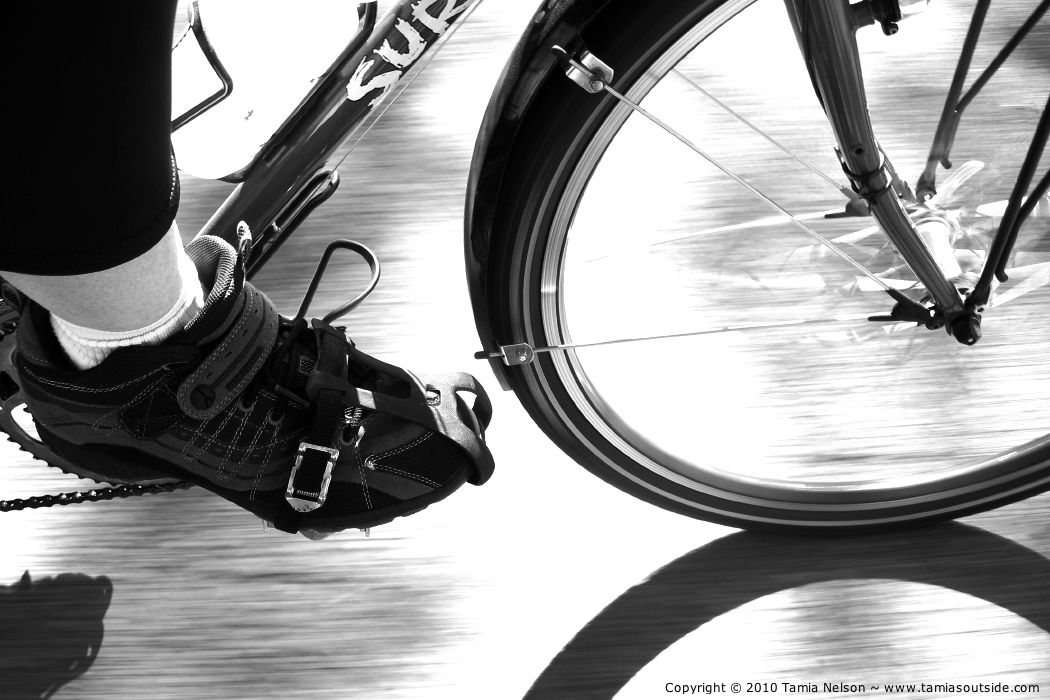 When I was 17 years old, I shattered my leg in a crash when downhill skiing, and as a consequence I spent five months in a full cast. My bones finally healed and my cast was removed, but my leg was weak, my knee would give out unexpectedly, and my leg hurt badly even after short walks. I began to despair of returning to my active lifestyle. But I had a new ten-speed bike. I lost patience with lameness, so one day I pushed the bike to the porch steps, cringed as I threw my bad leg over the saddle, and sat there with my good foot on the step and my bad foot on the pedal. It felt great to be back in the saddle, but could I ride? I shoved off and rolled onto the road. I COULD ride, I found to my delight. All that summer I cycled everywhere, and my bike brought me back to full strength. My good leg did the work and helped my bad leg to recover. I couldn't walk, but I could bike.
I'm sometimes asked why I cycle everywhere and in all weathers. The folks who ask me this question don't bike, so they can't comprehend without help. I try to explain, and I keep it simple. Mobility and freedom. That's why I ride. Beautiful countryside, the pride which comes from cycling well, and breaking away from car dependency are all icing on the cake.

Friday, November 19, 2010
Showers Pass Touring Jacket-user review
Love this jacket!
Showers Pass Touring Jacket. Showers Pass is out of Portland and is an exceptional company. "Showers Pass clothing is technically engineered cycling gear for racers, commuters, messengers and everyday cycling enthusiasts. Inspired by the challenging rides and weather of northern California and the Pacific Northwest, we have been combining top-notch fabrics with innovative, functional design elements since 1997. The result? Truly superior cycling outerwear." from the web site.
Showers Pass Touring Jacket
“The ultimate touring, commuter, and bike messenger jacket.”
Price: $150.00 Sizes s-XXL, Colors: Black, Blue, Yellow.
I own the Black Jacket in XXL
Review
 This jacket is made for bicycle people, but is great for hiking, cross country skiing, and running. Full cut so there is room to layer and extra mobility. Drop down tail to keep your butt dry in a deluge or warm in a snow storm. The ventilation, 12 inch two-way pit zips and large back vent is perfect. Highly reflective, choice of three colors, chamois collar, light loop on rear vent, chest pocket with audio port, two cargo pockets, cuffs are gusseted for air flow regulation. After four seasons of use the only problem is minor wear but integrity of jacket is strong. It is breathable, water proof, wind resistant, but is bulky and does not pack well.
I have used it biking and hiking in temperatures ranging from 5f degrees (layered) to 60f degrees. In rain, snow, sleet, drizzle, thunder storms, hail, wind, and even a tornado(kidding).
The ventilation is fantastic! Keeping the rider dry inside and out.
The only negative is the the drop down tail. I works great while riding, but sometimes can get caught on the seat when stopping at a intersection causing an anxious moment so the rider has to stand up off the saddle for the tail to clear the back of the saddle. Also the tail, when held up by two snaps, can sometimes come unsnapped when, bending over, which makes me annoyed because I have to check if it is up down- I think buttons instead of snaps could fix this problem.
Overall I give this jacket a 4 out of a possible 5 rating and would recommend it to all!
Reviewed by Bill Poindexter
 |
| A fantastic jacket! |
Showers Pass Touring Jacket
“The ultimate touring, commuter, and bike messenger jacket.”
Price: $150.00 Sizes s-XXL, Colors: Black, Blue, Yellow.
I own the Black Jacket in XXL
Review

I have used it biking and hiking in temperatures ranging from 5f degrees (layered) to 60f degrees. In rain, snow, sleet, drizzle, thunder storms, hail, wind, and even a tornado(kidding).
The ventilation is fantastic! Keeping the rider dry inside and out.
 |
| 30f degrees, sleet/ rain, wind, and I am warm and dry |
Overall I give this jacket a 4 out of a possible 5 rating and would recommend it to all!
Reviewed by Bill Poindexter
Thursday, November 18, 2010
James Osborne-carfree American profile-Denver, Colorado
Tell me a little bit about you (name, age, occupation, married, kids, carfree or carlite, where you live)?
James Osborne, 27. I have been married for 6 years and we are expecting our first little one next year. We live in Centennial, Colorado, a southern suburb of Denver and have for a few years. I try to be car-lite as much as practical, and my wife and I share one car.
When did you start using a bicycle for transportation and what other forms of transportation do you use?
About three years ago the car I had for several years started having serious issues, and I realized I was driving it less and less. We lived just a few blocks from a light rail station and it was very easy to ride to the station and take the train the 9 or 10 miles to my office. Finally I realized it was ridiculous to have a car sitting in front of our house that barely worked and I never drove, and we sold my car for pence.
What is a day in your bicycling life like?
In short, fantastic! Our house is about 8 miles from my office and it’s easy for my commute to be mostly on off-street paths or neighborhood roads. Riding feeds my eating habits and keeps my stress down. Commuting allows me to get a lot of riding in without taking too much time away from other things.
Do you recommend cycling to friends/family members/others? Have any taken you up on it?
I’ve slowly spread bikes among friends and family. I try not to be too self-righteous about it, as I realize it’s not for everyone. This year I convinced a co-worker to ride with me on Denver’s Bike To Work Day and she has been bike commuting about one day a week since then. I have other friends that ride and my brother-in-law has ridden his commute for quite a while.
What kind of bike are you currently riding?
My daily driver is a stock ’08 Surly Long Haul Trucker. I was riding a road bike before I started commuting regularly and prefer a road bike for rides of more than a few miles. Riding year round in Denver is usually a breeze, but we usually have to deal with a few weeks of snow. When the roads are bad I pull out a dedicated ice bike, an old rigid Trek mountain bike. On the advice of Peter White (http://www.peterwhitecycles.com//) I got some Nokian Mount & Ground studded tires, which I can’t imagine the winter without.
In your opinion, what’s the best part about cycling for transportation?
I have to pick just one? I suppose I would have to say getting to ride my bike every day. Sure there are health, environmental and financial benefits. But mostly, I just like riding my bike, and I like that commuting lets me ride my bike.
What’s the worst?
The occasional inconvenience of an out-of-office meeting or something out of my routine. All of life is a trade off, and there are downsides to driving that, in my opinion, far outweigh the downsides to biking.
Do you have a favorite carfree/carlite story?
I love the first warm spring ride, when I can leave the house in the morning without a jacket and in shorts. I love jumping on my ’74 Schwinn Collegiate for a cruise to the grocery store or the bank. I love riding adjacent to bumper-to-bumper traffic and realizing that I don’t have to be part of that if I don’t want to.
What are three pieces of advice you would give to someone starting/ considering commuting by bike?
1) Ease your way in; don’t feel obligated to spend $1,000 on a new bike and gear just to try it.
2) If you know someone who rides a lot, talk to them about what routes they might suggest.
3) Ride when you want to. If it becomes an obligation quickly, you won’t want to ride!
Anything else you would like to add?
The best bike is the one you want to ride.
Thanks James and congrats on being pregnant!!! I see a trailer is in your future!
Read more about James and his carfree life at
http://onelessindenver.blogspot.com/
 |
| Cargo bikes work for transportation too! |
When did you start using a bicycle for transportation and what other forms of transportation do you use?
About three years ago the car I had for several years started having serious issues, and I realized I was driving it less and less. We lived just a few blocks from a light rail station and it was very easy to ride to the station and take the train the 9 or 10 miles to my office. Finally I realized it was ridiculous to have a car sitting in front of our house that barely worked and I never drove, and we sold my car for pence.
What is a day in your bicycling life like?
In short, fantastic! Our house is about 8 miles from my office and it’s easy for my commute to be mostly on off-street paths or neighborhood roads. Riding feeds my eating habits and keeps my stress down. Commuting allows me to get a lot of riding in without taking too much time away from other things.
Do you recommend cycling to friends/family members/others? Have any taken you up on it?
I’ve slowly spread bikes among friends and family. I try not to be too self-righteous about it, as I realize it’s not for everyone. This year I convinced a co-worker to ride with me on Denver’s Bike To Work Day and she has been bike commuting about one day a week since then. I have other friends that ride and my brother-in-law has ridden his commute for quite a while.
 |
| James and his Surly Long Haul Trucker |
My daily driver is a stock ’08 Surly Long Haul Trucker. I was riding a road bike before I started commuting regularly and prefer a road bike for rides of more than a few miles. Riding year round in Denver is usually a breeze, but we usually have to deal with a few weeks of snow. When the roads are bad I pull out a dedicated ice bike, an old rigid Trek mountain bike. On the advice of Peter White (http://www.peterwhitecycles.com//) I got some Nokian Mount & Ground studded tires, which I can’t imagine the winter without.
 |
| Ice biking! |
I have to pick just one? I suppose I would have to say getting to ride my bike every day. Sure there are health, environmental and financial benefits. But mostly, I just like riding my bike, and I like that commuting lets me ride my bike.
What’s the worst?
The occasional inconvenience of an out-of-office meeting or something out of my routine. All of life is a trade off, and there are downsides to driving that, in my opinion, far outweigh the downsides to biking.
Do you have a favorite carfree/carlite story?
I love the first warm spring ride, when I can leave the house in the morning without a jacket and in shorts. I love jumping on my ’74 Schwinn Collegiate for a cruise to the grocery store or the bank. I love riding adjacent to bumper-to-bumper traffic and realizing that I don’t have to be part of that if I don’t want to.
What are three pieces of advice you would give to someone starting/ considering commuting by bike?
1) Ease your way in; don’t feel obligated to spend $1,000 on a new bike and gear just to try it.
2) If you know someone who rides a lot, talk to them about what routes they might suggest.
3) Ride when you want to. If it becomes an obligation quickly, you won’t want to ride!
Anything else you would like to add?
The best bike is the one you want to ride.
Thanks James and congrats on being pregnant!!! I see a trailer is in your future!
Read more about James and his carfree life at
http://onelessindenver.blogspot.com/
Subscribe to:
Posts (Atom)